
If you live in Palm Beach County or anywhere along the South Florida coast, you’ve probably noticed something the rest of the country doesn’t have to deal with quite as much: your driveway, roof, or siding starts looking dirty again faster than you’d expect. That’s not your imagination — and it’s not because you’re doing anything wrong. It’s just Florida.
Why South Florida Homes Get Dirty Faster
Three things work against your home’s exterior here:
- Humidity — South Florida’s warm, wet air is the perfect breeding ground for algae, mold, and mildew. That black streaking you see on roofs and the greenish tint on shady walkways? That’s algae, not dirt.
- Heavy rain — Frequent rain drives dirt, pollen, and organic material into siding, pavers, and driveways, then keeps them damp long enough for growth to take hold.
- Coastal air — If you’re near the water, salt air speeds up grime buildup and can be tougher on exterior surfaces over time.
Combine all three, and a home that would stay clean for a year up north might need attention twice as often here.
So, How Often Should You Actually Clean?
Here’s a general guideline for homeowners in our area:
Driveways and walkways: every 6–12 months
Concrete and pavers are magnets for algae and tire stains. Cleaning once or twice a year keeps stains from setting in permanently — the longer algae sits, the harder (and more expensive) it is to remove.
Roofs: every 12–24 months
Those black streaks are algae eating away at your shingles or tiles over time. Beyond curb appeal, letting it go too long can actually shorten your roof’s lifespan. Soft washing (more on that below) is the safe way to handle this.
Siding and exterior walls: every 12 months
Stucco and siding hold onto humidity and grime. An annual wash keeps mildew from creeping into cracks and seams.
Pool decks and patios: every 6–9 months
These stay damp longer than almost any other surface on your property, which means algae and mildew take hold fast — especially in shaded areas.
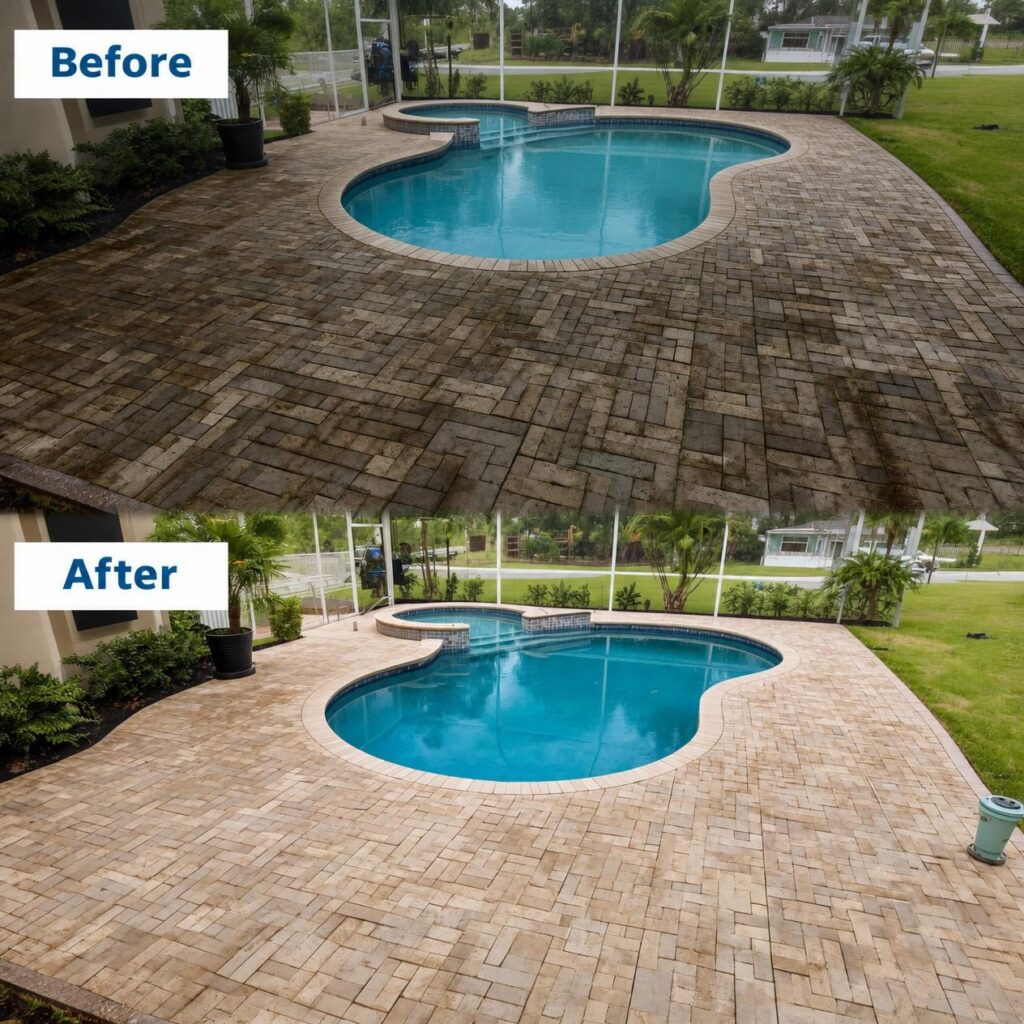
A recent Panther Power Wash job — years of built-up grime lifted from these pavers in a single visit.
Fences and outdoor structures: every 12–18 months
Wood and vinyl fencing can develop green and black buildup, especially on sides that don’t get much direct sun.
Pressure Washing vs. Soft Washing — What’s the Difference?
This is one of the most common questions we get, and it matters more than people think:
- Pressure washing uses high-powered water spray and works great on tough, durable surfaces like concrete driveways and pavers.
- Soft washing uses lower pressure combined with specialized cleaning solutions, making it the safer choice for roofs, siding, screens, and more delicate surfaces — it kills algae at the root instead of just blasting it off, so surfaces stay cleaner longer.
Using the wrong method on the wrong surface can cause real damage, which is why knowing which approach fits which job matters.
A Simple Rule of Thumb
If you’re not sure whether it’s time, take a walk around your property and look for:
- Black streaks on the roof
- Green or dark patches on concrete or pavers
- A slippery feel on walkways or pool decks
- Dingy, dull-looking siding that used to look brighter
If you’re seeing any of these, it’s probably time.
Keep Your South Florida Home Looking Its Best
Between the humidity, rain, and salt air, South Florida just isn’t kind to exterior surfaces — but a regular cleaning schedule keeps your home looking sharp and helps protect your investment for the long run.
Ready for a free quote? Contact Panther Power Wash today and let us handle the dirty work — from driveways and roofs to pool decks and fencing, we’ve got South Florida homes covered.
📞 Call or text us at (305) 450-2505
📷 Follow us on Instagram @pantherpowerwash for before/after photos of recent jobs
■ Panther Power Wash — (305) 450-2505 | ■ @pantherpowerwash
If you live in Palm Beach County or anywhere along the South Florida coast, you’ve probably noticed
something the rest of the country doesn’t have to deal with quite as much: your driveway, roof, or siding
starts looking dirty again faster than you’d expect. That’s not your imagination — and it’s not because
you’re doing anything wrong. It’s just Florida.
Why South Florida Homes Get Dirty Faster
Three things work against your home’s exterior here:
• Humidity — South Florida’s warm, wet air is the perfect breeding ground for algae, mold, and
mildew. That black streaking you see on roofs and the greenish tint on shady walkways? That’s
algae, not dirt.
• Heavy rain — Frequent rain drives dirt, pollen, and organic material into siding, pavers, and
driveways, then keeps them damp long enough for growth to take hold.
• Coastal air — If you’re near the water, salt air speeds up grime buildup and can be tougher on
exterior surfaces over time.
Combine all three, and a home that would stay clean for a year up north might need attention twice as
often here.
So, How Often Should You Actually Clean?
Here’s a general guideline for homeowners in our area:
Driveways and walkways: every 6–12 months
Concrete and pavers are magnets for algae and tire stains. Cleaning once or twice a year keeps stains
from setting in permanently — the longer algae sits, the harder (and more expensive) it is to remove.
Roofs: every 12–24 months
Those black streaks are algae eating away at your shingles or tiles over time. Beyond curb appeal,
letting it go too long can actually shorten your roof’s lifespan. Soft washing (more on that below) is the
safe way to handle this.
Siding and exterior walls: every 12 months
Stucco and siding hold onto humidity and grime. An annual wash keeps mildew from creeping into
cracks and seams.
Pool decks and patios: every 6–9 months
These stay damp longer than almost any other surface on your property, which means algae and
mildew take hold fast — especially in shaded areas.Fences and outdoor structures: every 12–18 months
Wood and vinyl fencing can develop green and black buildup, especially on sides that don’t get much
direct sun.
Pressure Washing vs. Soft Washing — What’s the Difference?
This is one of the most common questions we get, and it matters more than people think:
• Pressure washing uses high-powered water spray and works great on tough, durable surfaces
like concrete driveways and pavers.
• Soft washing uses lower pressure combined with specialized cleaning solutions, making it the
safer choice for roofs, siding, screens, and more delicate surfaces — it kills algae at the root
instead of just blasting it off, so surfaces stay cleaner longer.
Using the wrong method on the wrong surface can cause real damage, which is why knowing which
approach fits which job matters.
A Simple Rule of Thumb
If you’re not sure whether it’s time, take a walk around your property and look for:
• Black streaks on the roof
• Green or dark patches on concrete or pavers
• A slippery feel on walkways or pool decks
• Dingy, dull-looking siding that used to look brighter
If you’re seeing any of these, it’s probably time.
Keep Your South Florida Home Looking Its Best
Between the humidity, rain, and salt air, South Florida just isn’t kind to exterior surfaces — but a regular
cleaning schedule keeps your home looking sharp and helps protect your investment for the long run.
Ready for a free quote? Contact Panther Power Wash today and let us handle the dirty work — from
driveways and roofs to pool decks and fencing, we’ve got South Florida homes covered.
■ Call or text us at (305) 450-2505
■ Follow us on Instagram @pantherpowerwash for before/after photos of recent jobs